Where Boutiques Buy Their Clothes: Trade Shows, Showrooms and the Prato District
26 October 2026

Sourcing Strategy
Most advice on wholesale fall clothing assumes a cold season: wool coats, heavy knits, layers that customers wear for months. For boutiques in the Gulf, southern Australia, parts of the United States or the Mediterranean, the season looks different. Winter is short and mild, evenings are cool rather than cold, and customers buy autumn-winter pieces as much for occasions and style as for warmth. A rail full of heavy outerwear in that climate sells slowly and ends the season on discount, while lighter statement pieces sell at full price from the first cool week.
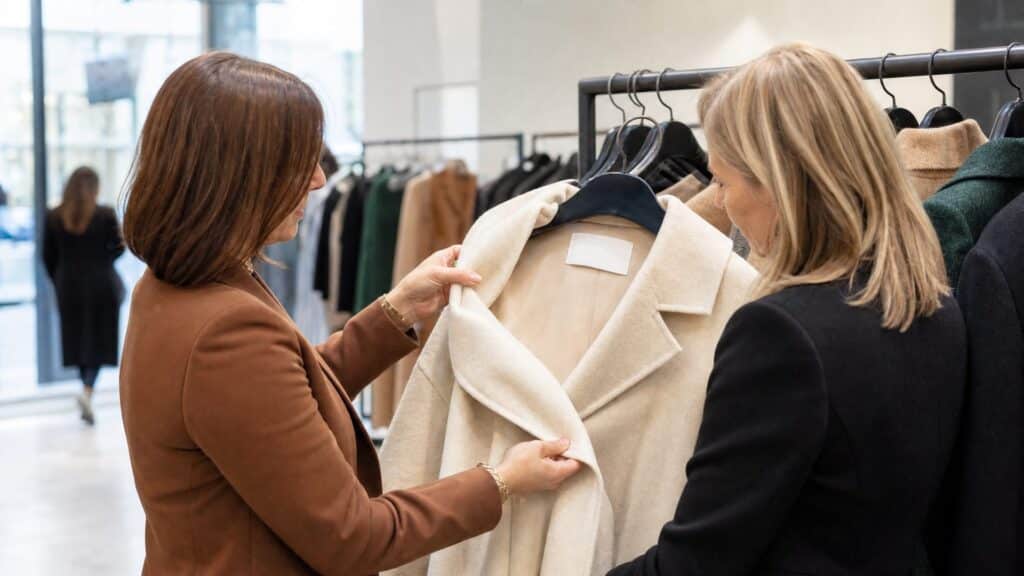
That was the situation of a Kuwait City boutique that came to Prato at the end of August to buy its autumn-winter assortment. The owners knew their customers well after more than twenty years in retail, and they arrived with reference photos of pieces that had sold in their store. Their brief was clear: distinctive jackets, feminine tailoring and coordinated outfits with a strong visual identity, in a price range that suited a boutique positioned above the mass market. Heavy winter basics were not part of the plan.
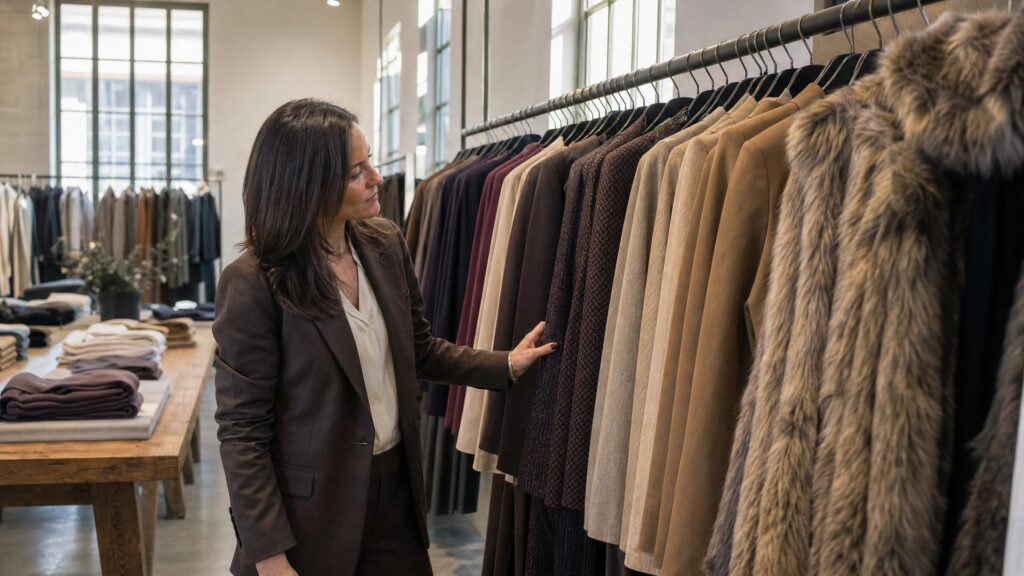
The order that came out of the trip was built on four categories. The first was faux fur jackets and coats, the clearest signal of the season on a rail, which customers in a mild climate wear in the evening and for events. Our article on faux fur and teddy coats wholesale from Prato explains how to read pile quality and backing. The second was feminine blazers and jackets, structured enough to look autumnal but light enough for indoor wear in air-conditioned spaces.
The third category, and the largest by number of styles, was coordinated sets: long and short kimono jackets with matching trousers, and in some cases a blouse or top, sold as complete outfits in rich autumn colours. These sets suit a climate where a single layer is enough and customers like a finished look. The fourth was a selection of padded jackets in light constructions, plus belts and small accessories to complete the outfits. Across all four, the owners favoured pieces with a strong visual identity over basics, because basics are easy to find locally and rarely bring a customer back to the store a second time.
Weight is the first adjustment for a warm-climate store. Fabrics that read as autumn, such as velvet, satin with a heavier hand, textured jacquards and soft faux fur, can be worn comfortably at temperatures that would make a wool coat impossible. The Kuwait owners checked weight piece by piece in the showrooms, which is one of the reasons they wanted to buy in person: a photograph shows colour and cut, but it cannot tell a buyer whether a jacket will be pleasant to wear on a mild evening.
Colour carried the seasonal message instead. The coordinated sets were ordered in deep greens, bronze, tobacco, mustard, rust, navy and dark brown, often with two-tone combinations such as military green with yellow, and the jackets added neutrals and darker shades around them. Sizes were adjusted to the customer base: for the sets with long kimono jackets, quantities in the smallest size were moved to the largest, because the owners knew which sizes sold first in their store. Decisions like these are where a buyer’s local knowledge meets the supplier’s range.
Timing affects what a warm-climate store can buy. Prato reopens after the August break in the last week of the month with the first autumn-winter collections, and the best pieces move quickly because buyers from many countries arrive at the same time. The Kuwait owners visited ten suppliers between 26 and 28 August, early enough to see full collections and to order on the spot, which we recommended because pronto moda styles are often sold out within a week or two.
For a boutique whose cool season starts in November and peaks around the turn of the year, an order placed at the end of August can be in store well before customers start buying. The Kuwait order also included the boutique’s own neck labels on most garments, which added a few weeks for label production and relabeling before collection, and the owners asked for the goods to arrive in two shipments so their team could receive them alongside deliveries from other sources. Our overview of Italian winter clothing wholesale covers the wider calendar for colder markets.
Prato is best known for garments made in Italy, and most of what the Kuwait boutique bought carried that origin. Some of the styles the owners first asked for, however, especially certain faux fur jackets and coats, were available from suppliers who produce them in China. Our buyer said so before any order was written, and the owners answered that origin mattered less to them than design, quality and price: if a piece was right for their customers, they would buy it with its true origin declared. That choice widened the selection without any ambiguity about what the store was selling.
A mixed order needs care in two places. On the garments, each piece keeps the composition and origin label sewn in by its supplier, and any label the boutique adds carries only the store’s name, which is why the owners removed the words Made in Italy from their own neck label. On the documents, the export invoice states the origin of every line, so customs at destination see exactly what is in the cartons. Handled this way, a mixed-origin order is as straightforward to sell and to import as a single-origin one.
Once the goods were bought, the owners raised a question that many boutiques face: product photos. They wanted high-resolution images of every style they had selected, for their social channels and advertising, so they could start promoting the new season before the garments arrived. We contacted all ten suppliers. A few promised some material, most had nothing of professional quality, and whatever existed rarely matched the colours the boutique had chosen. In the meantime we shared our own photos of the selected pieces, taken in our warehouse. This is common in pronto moda, where suppliers sell from the rail and change collections too quickly to photograph them.
The practical solution is to photograph the order in Italy, while the garments pass through quality control and before they are packed. Each style can be shot front and back in every colour, with files named by style code and ready to upload. Our product photography and video service does exactly this for orders that go through our warehouse, so a boutique receives its images together with, or before, its goods, and can start selling the season from the day the cartons are opened.
For a boutique in a warm climate, the most useful planning step is to define the season by occasion rather than by temperature. Which evenings, events and holidays will customers dress for, and what do they wear when the air is cool but not cold. The answers point to categories like those in the Kuwait order: statement jackets, light tailoring, coordinated sets and a few warm layers, chosen with care for fabric weight and colour. Heavy basics can then be limited to what the store knows it can sell, ideally bought locally or in small depth, so that most of the open-to-buy budget goes to the pieces that give the rail its character.
Wholesale fall clothing bought this way tends to sell at full price for longer, because it matches how customers in mild climates actually dress. Buying early in the Prato season, in person or by live video, gives the widest choice, while planning labels and product photos at the same time means the goods arrive ready for the shop floor and for the store’s online channels. The Kuwait boutique is already planning its next visit to Prato.
Italian fashion supply, curated and delivered to your inbox.
How can we assist?
See our services