Velvet Dresses for the Winter Evening: Stretch Velvet, Devoré and Satin Bias Cuts
13 November 2026
Sourcing Strategy
Most boutiques build their party rail between August and October, choosing shapes and colours months before their customers have decided what to wear. By the second week of December the picture is clearer, and it rarely matches the plan: one black sequin mini has gone in three sizes, the emerald velvet is still full, and the New Year’s Eve dresses that customers ask for by description are no longer on the rail. A December restock is how a store corrects that gap while there are still parties left to dress for.
The general logic of the holiday assortment, with its mix of shine, knit and accessories, is covered in our guide on sourcing winter dresses and occasionwear for the holiday season, and this article picks up where that one ends. The question here is narrower and more urgent, because it concerns the last six weeks of the year, when the buyer already knows what is selling and needs to find more of it quickly enough for the dresses to reach the shop floor before the 31st.
The Prato district works on short cycles. Its warehouses design, cut and sew continuously instead of releasing two collections a year, so a showroom that was full of knitwear in October will usually have a rail of party pieces by late November, with new arrivals added week by week. For a boutique this means that wholesale party dresses are still being made in December, often in the same fabrics and silhouettes that are selling in its own store.
This is the structural advantage described in our article on in-season buying with Italian pronto moda, and it is particularly useful for occasionwear. A buyer who missed the right shade of satin in September, or who sold through a sequin style faster than expected, can often find it again or find a close equivalent, since several warehouses tend to work on the same seasonal codes at the same time. What changes in December is the speed at which stock moves: popular pieces leave the showroom within days, so decisions have to be taken during the session rather than after it.
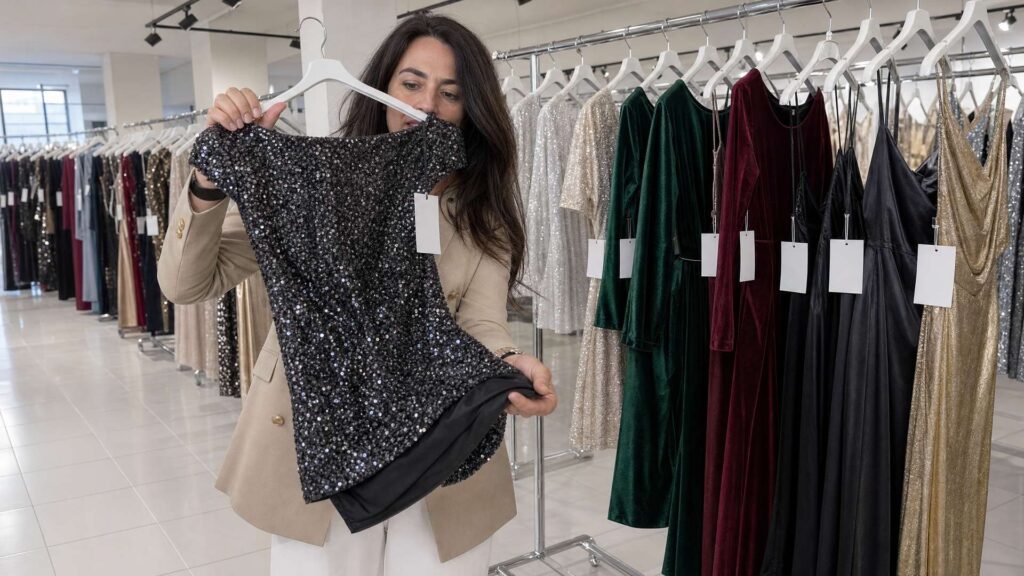
A restock works best when it starts from the sales data of the previous three or four weeks rather than from what looks festive on the screen. If a short black sequin dress sold through in sizes 40 and 42, the priority is to replace that shape in those sizes, perhaps adding a second colour such as silver or champagne, and to stop there. Customers shopping for New Year’s Eve dresses in the final fortnight tend to buy what they have already seen on friends or on social media, so repeating a proven silhouette is usually safer than introducing a completely new one.
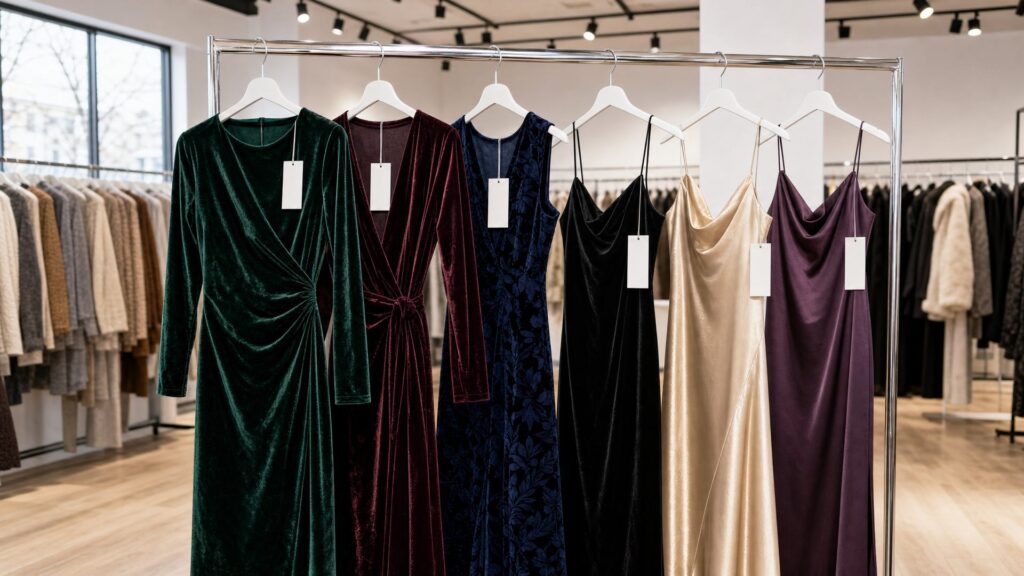
Velvet behaves differently from sequins in the last weeks of December. It sells well for Christmas dinners and family gatherings, and then slows down as the 31st approaches, when shine takes over the rail. A buyer who still has velvet in stock on the 15th should probably restock sequins, lamé and satin instead, while a store that sold its velvet early may want a small second delivery for the period between Christmas and the first week of January, when invitations to dinners continue. In both cases the depth should stay modest, two or three pieces per size, because a December restock is meant to fill gaps, not to open a new season.
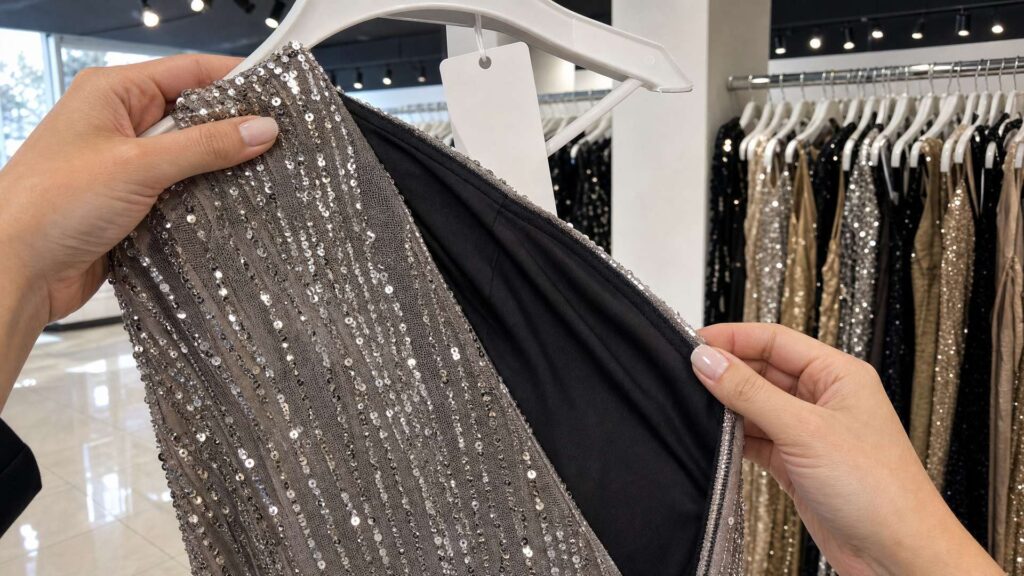
Party dresses are the category where quality differences are easiest to miss on a screen. During a live buying session the buyer can ask to see the inside of the dress, and that is where most problems become visible: sequins sewn onto a loose base, or a lining that stops well above the hem. A good presenter turns the garment to show the back and stretches the fabric gently in front of the camera, so that the buyer is judging the dress as it will be worn and not only its front view under the showroom lights.
Fit deserves the same attention, because sizing in Italian pronto moda often runs on a small number of base sizes, and a dress cut close to the body may be offered in two sizes only. Asking for the measurements of the bust and hips before confirming the order avoids returns in a period when the customer has no time to wait for an exchange. Composition matters too, since a polyester sequin dress with a stretch lining and a viscose satin slip will need different handling in store, and the information is already on the composition and care labels sewn inside each piece.
A restock that arrives on the 30th is too late for most stores, so the calendar has to be worked backwards from the date the dresses need to be on the rail. In our experience the sequence is fairly predictable, because the suppliers are scouted on the basis of the buyer’s brief before the live session and the order is confirmed during the call itself. Payment should be completed as soon as possible after confirmation, since many warehouses do not hold party pieces for long in December, and once the shipment is paid on a weekday morning the goods usually leave Italy within 24 hours.
Transit by courier generally takes up to five working days, with possible delays at customs depending on the destination, which means that a session held in the first days of December leaves a comfortable margin for most markets. A session held around the 15th is still workable for many countries, but it leaves less room for error, especially if the store needs a couple of days to steam and tag the dresses before putting them out. For buyers in different time zones, sessions can often run into the Italian evening, until 8 or 9 pm depending on showroom availability, which makes it easier to fit a call into a busy retail week.
The risk of a December restock is obvious: party dresses that are not sold by New Year’s Day lose most of their appeal overnight. A sensible approach is to restock only the styles with a proven sell-through and to choose, where possible, pieces that can live beyond the 31st. A black satin slip dress, a velvet midi in a dark colour or a knitted dress with lurex can still be sold in January for dinners and weddings, while a short silver sequin mini is far harder to move once the decorations come down.
Some stores also split the restock into two small deliveries, the first aimed at office parties and Christmas, the second at New Year’s Eve, which lets the buyer read the response to the first shipment before committing to the second. This requires a little more coordination with the suppliers, because the same style may not be available ten days later, but it keeps the risk proportionate to the time left in the season. Consolidating both deliveries into one invoice per shipment also keeps the paperwork simple for the store’s accountant at the end of the year.
The December restock also produces information that is hard to get any other way. The notes on which styles sold out and which sizes ran short make a better brief for next year’s party buying than any trend report, and it is worth writing them down before January sales overwrite the memory of what happened. Buyers who track this tend to place a more accurate first order in the autumn and need a smaller restock in December, which is cheaper in terms of time and attention.
For boutiques that want to act on this season, the fastest route is a remote session through our live buying service from the Prato warehouses, prepared around the styles that have already sold. A good December restock of New Year’s Eve dresses usually looks a lot like the October order, only shorter and more precise, and in the Prato district the warehouses are still producing while the trade fairs for the season are long over.
Italian fashion supply, curated and delivered to your inbox.
How can we assist?
See our services