Velvet Dresses for the Winter Evening: Stretch Velvet, Devoré and Satin Bias Cuts
13 November 2026
Sourcing Strategy
Weddings no longer belong only to the summer. Many couples now choose winter dates for practical reasons, from venue availability to the appeal of a candlelit ceremony, and their guests arrive in boutiques looking for something elegant that will also keep them warm. Winter wedding guest dresses therefore form a demand that starts in November and continues into March, well after the holiday party rail has been cleared, and stores that treat them as a category in their own right tend to capture sales that would otherwise go to department stores.
The customer is also different. A woman buying for a wedding usually has a date and a dress code in mind, and she wants a piece that looks appropriate in daylight photographs as well as at the evening reception. Our overview of wholesale dresses from Italy and the styles boutiques buy covers the broader dress assortment, and this article narrows the focus to the guest dress, which follows its own logic in terms of shape, fabric and timing.
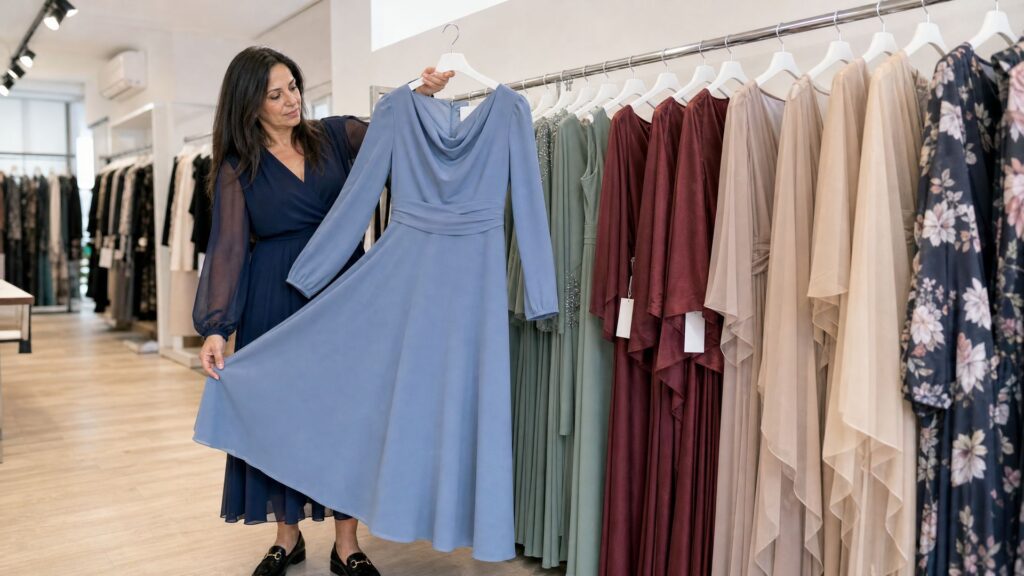
Long sleeves are the single most requested feature. A fitted or slightly blouson sleeve in crepe or satin lets the guest skip a bulky jacket during the ceremony and still feel covered in a cold church or town hall. Midi lengths lead the category because they suit almost every age and dress code, while maxi dresses sell to stores with a strong ceremony clientele or customers who attend formal evening receptions, especially in markets where longer hems are expected.
Necklines tend to be softer and higher than on party dresses, with draped fronts, small V-necks and tie collars. Wrap shapes and dresses with a defined waist are easy to sell because they flatter many figures and adapt to a range of sizes. In the Prato showrooms these silhouettes appear in many variations, from plain crepe to printed chiffon with a lining, and a buyer who knows her customers can usually cover the main needs with five or six well chosen styles in modest depth.
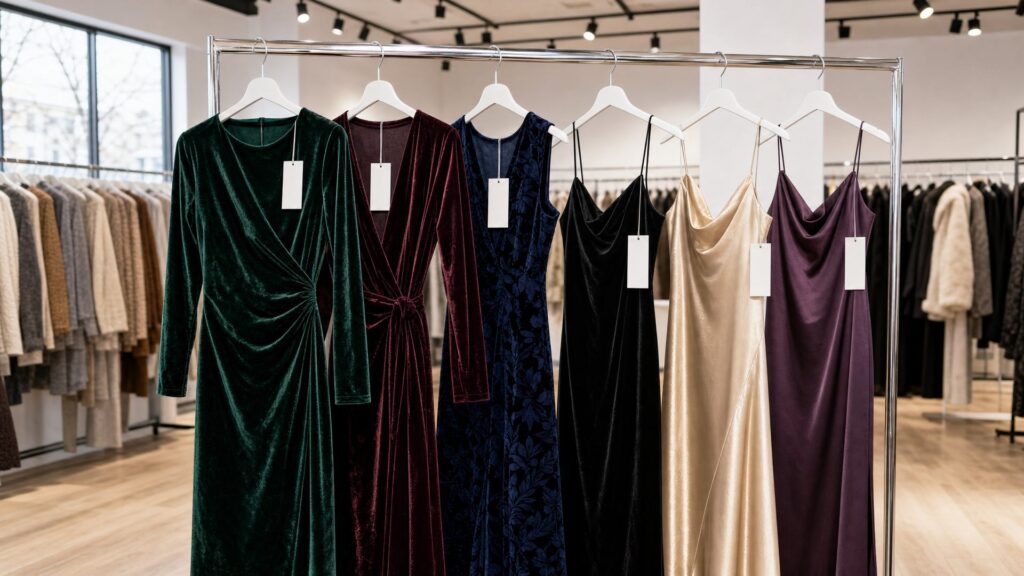
Fabric choice decides how a winter guest dress looks after six hours of wear. Heavy crepe and satin-back crepe hold their shape and resist creasing, which matters for a guest who sits through a long ceremony and a dinner. Lined chiffon gives movement and lightness for indoor receptions, and soft satin brings a little shine for the evening without looking like a party piece. Velvet can work for very formal winter weddings, although many guests find it too warm once the dancing starts.
Colours follow the season and the etiquette. White, ivory and very pale cream are best left off a guest rail altogether, and black sells less than one might expect in some markets, where it is still associated with mourning. Deep greens, burgundy, navy, dusty blue and soft mauve are safe choices for winter wedding guest dresses, and floral prints on a dark ground give an option for daytime ceremonies. Reading the composition labels during the session helps the buyer separate fabrics that travel well from those that will need careful steaming on arrival.
Layering pieces are worth considering at the same time. A guest who chooses a sleeveless or short sleeve dress will look for a cover for the ceremony, and a fine knit bolero or a cropped tailored jacket in a matching tone can be sold together with the dress. Showrooms in Prato often carry these toppers next to the occasion rail, sometimes in coordinated colours, and adding a few of them to the order turns a single dress sale into a complete outfit. They also extend the life of summer guest dresses that customers already own, which brings in shoppers who are not buying a new dress this time.
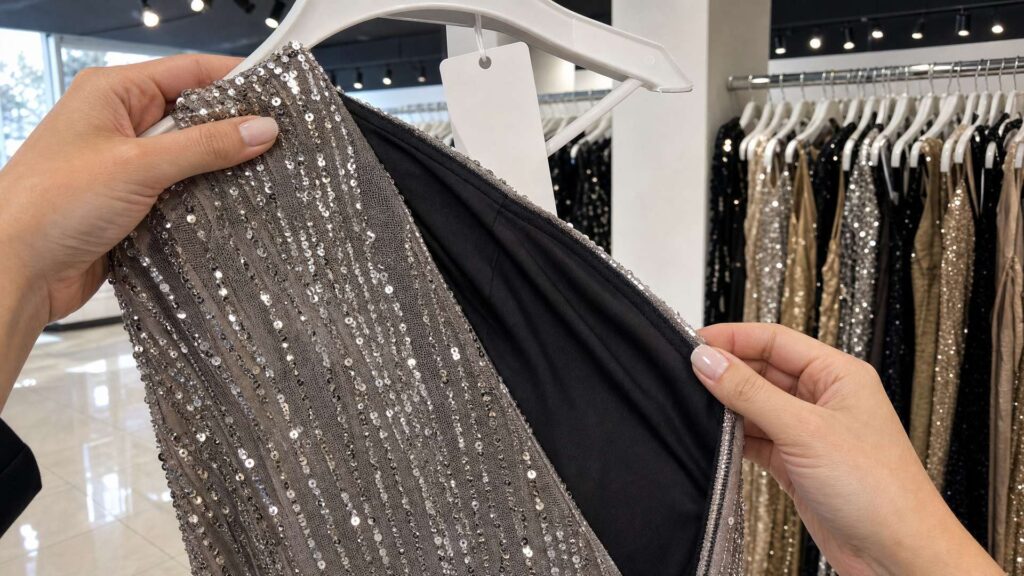
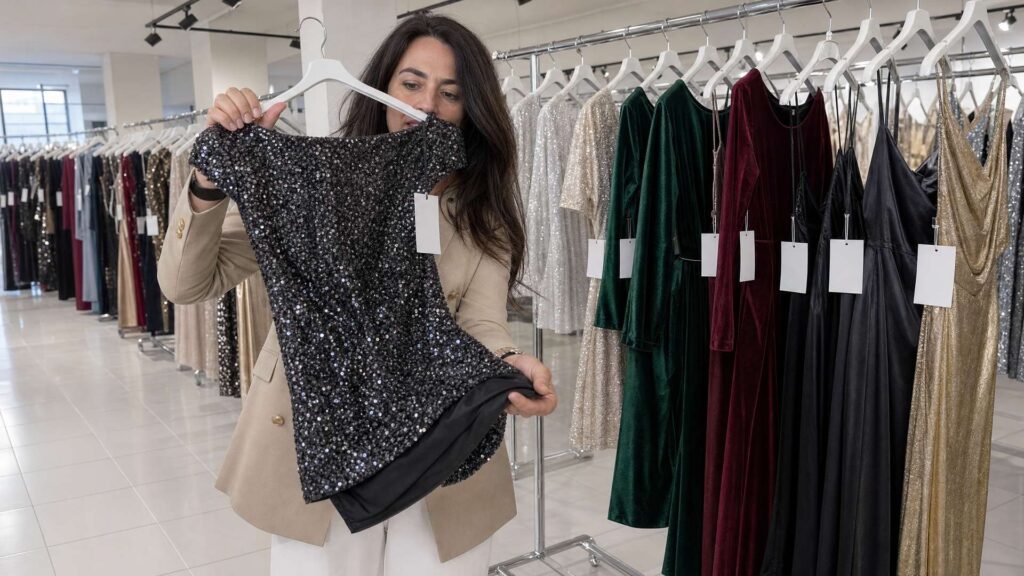
A common mistake is to place guest dresses on the same rail as sequin party pieces. The customer looking for a wedding outfit in January walks past shine she cannot wear to a ceremony, and the party rail loses its focus too. Stores that separate the two, even with a small display or a dedicated rail near the fitting rooms, find that the guest dresses sell more steadily, because the customer immediately sees that the shop understands what she needs.
The separation also helps planning. Party stock has a hard deadline on the 31st of December, while guest dresses keep selling into the spring, which allows the buyer to order them with a little more depth and to accept a slightly longer sell-through. Accessories reinforce the category, and our article on completing the autumn-winter assortment with accessories explains how scarves and bags add value to the basket when a customer is building a complete wedding look.
Guest dresses are often bought close to the wedding date, and the customer has little time for exchanges. Checking the size range offered for each style is therefore essential. Many pronto moda dresses are cut in a short run of base sizes, and fitted styles may come in only two sizes, while wrap dresses and softly draped shapes cover a wider range. Asking for the measurements of the sample laid flat, at the bust and along the full length, gives the buyer a clear idea of fit before she commits.
Simple construction also makes alterations easier for stores that offer them. A dress with a plain hem in crepe can be shortened in minutes, while a chiffon dress with a lining and a decorated hem needs more work and more skill. Buyers who serve an older clientele often prefer styles with a little ease at the waist and sleeves that can be adjusted, because these reduce the number of returns and make the fitting room experience calmer for both the customer and the staff.
Mothers of the bride and groom form a group of their own within the category. They usually look for a more structured dress or a coordinated dress and jacket, in fabrics with some weight and in colours agreed with the couple, and they shop earlier than other guests. A boutique that keeps two or three of these pieces in its core sizes, with a jacket option, can serve a customer who tends to spend more and who often returns for other occasions during the year. In a live session, the buyer can ask the presenter to show the lining and the inside of the jacket, since this customer notices finishing details.
The guest dress season unfolds in waves, starting with ceremonies around the holidays and continuing through January and February, when many couples choose quieter dates, until the first spring weddings in March. A boutique can split its buying in the same way, with an initial order in the autumn and a top-up in January, once the first sales have shown which shapes and colours are moving in that particular store.
Pronto moda suits this rhythm because the showrooms keep adding new pieces through the winter. A live session in January can find fresh guest dresses in the colours that are selling, and once the order is paid and the shipment is paid on a weekday morning, the goods usually leave Italy within 24 hours, with transit of up to five working days for most destinations, customs permitting. That timing leaves room for a second delivery well before the February and March ceremonies.
Most of the guest dresses offered in the Prato district are made in Italy, and some suppliers also carry pieces made in China, which are always declared clearly before the purchase. Buyers can therefore decide which origin suits each price point on the rail. Through our sourcing and purchasing service in Prato, the dresses chosen across several showrooms are consolidated into one invoice and one shipment, which keeps the operation simple even when the order mixes different suppliers and fabrics.
A small, well structured selection is usually enough to build a reputation for occasionwear. A handful of long sleeve midi shapes in winter colours, with a printed option and perhaps one maxi style, can cover most requests, as long as they are chosen around the store’s own clientele. Treated as a category with its own rail and its own calendar, winter wedding guest dresses turn the quieter months after the holidays into a period with steady, predictable sales.
Italian fashion supply, curated and delivered to your inbox.
How can we assist?
See our services