Wholesale Party Dresses: Judging Sequins, Lining and Stretch Before You Order
11 November 2026
Fabric & Materials
When temperatures drop and the invitations start arriving, velvet is the fabric customers reach for to look dressed without feeling cold. Velvet dresses carry colour in a way few other finishes can, with deep greens, wine reds and midnight blues that look richer in the evening light than they do on a hanger. For a boutique this makes velvet one of the few occasion categories that sells across December and well into February, with office dinners in December and winter weddings well after the holidays.
The role velvet plays alongside sequins and knit in a holiday assortment is set out in our guide on sourcing winter dresses and occasionwear from Italy. This article looks more closely at the garments themselves, because the velvet dresses offered in the Prato showrooms come in a few distinct constructions, and choosing between them changes how the rail performs and how many pieces come back after the first wear.
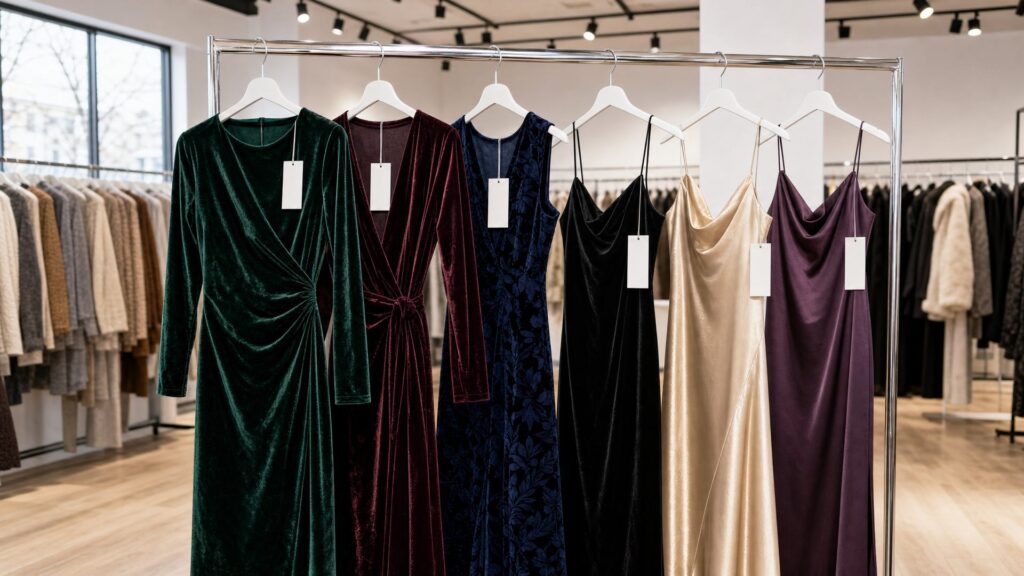
Most velvet dresses in pronto moda are made in stretch velvet, a knitted velvet with a small percentage of elastane that gives the fabric movement and recovery. It is forgiving on the body, comfortable to sit in for a long dinner and simple to care for, since many pieces can be washed gently rather than sent to the cleaner. These qualities make stretch velvet the safest base for a boutique that wants to offer wholesale evening dresses to a broad clientele without worrying about fit returns.
The shapes that work best are the simple ones, typically long sleeves with a round or square neckline and a midi length that suits both a restaurant and a wedding. In the showroom the buyer should look at how the pile lies across the seams, because stretch velvet has a direction, and pieces cut with panels in opposite directions show two different shades under the light. During a live session it helps to ask the presenter to move the dress slowly under the spotlight, which reveals whether the colour stays even across the whole garment.
Devoré is velvet in which part of the pile has been burnt away with a chemical paste, leaving a pattern of plush motifs on a sheer ground. The result is lighter and more delicate than plain velvet, with a drape that moves beautifully on the body. Devoré velvet dresses suit a customer who wants something less obvious than sequins for a special evening, and they photograph well, which matters for stores that sell part of their stock through social media or an online shop.
These pieces need more attention from the buyer. The sheer areas often require a slip or a full lining, and a dress that looks elegant on a hanger can be too transparent once worn. Composition labels deserve a careful read, since devoré is often made on a viscose and silk base, which affects care and the way the dress should be stored in the shop. Our article on judging Italian silk by weave and weight explains why silk content changes both the hand and the expectations of the customer at the till.
The satin slip dress cut on the bias has become a fixture of evening rails, and it pairs naturally with velvet because the two finishes balance each other. Bias cutting means the fabric runs diagonally across the body, so the dress follows the figure and moves with every step. It is flattering on many customers but also unforgiving, because satin shows every seam and every crease, and a poorly cut bias dress twists around the body after a few hours of wear.
In the showroom the buyer can check the side seams by holding the dress up by the shoulders: a well cut bias slip hangs straight, while a weaker one rotates slightly towards one side. Satin in pronto moda is usually polyester or viscose, sometimes with a small silk content, and the sheen varies a great deal from one supplier to the next. Placing two candidates side by side in front of the camera makes those differences visible, and it avoids choosing a satin that looks rich on a phone screen but cheap under the lights of the shop.
Velvet tends to sell in dark, saturated colours, and the palette for this winter fits that pattern, with emerald, burgundy, chocolate and deep blue next to the inevitable black. Satin can carry lighter tones such as champagne or a dusty pink, which brighten the rail and give the customer an alternative to velvet for warmer venues. A small group of two or three velvet shapes and two satin slips is usually enough for an independent store, ordered in modest depth across the core sizes.
Length is the other decision. Midi lengths sell to the widest range of ages and occasions, while minis in velvet appeal to a younger customer for parties and long gowns stay a niche unless the store has a strong ceremony clientele. Buyers who want velvet dresses to sell past the holidays should lean towards midis in dark colours, which work for January weddings and dinners as well as for Christmas, and keep the more festive pieces to a smaller share of the order.
Climate and culture shift these choices from one market to another. A boutique in a mild-winter country will sell lighter stretch velvet and satin more easily than heavy plush pieces, and often in brighter shades for evenings outdoors. Stores in the Gulf usually look for long sleeves and longer hems, which velvet handles well because the fabric keeps its shape at full length. In Northern Europe velvet is worn with tights and boots, so slightly shorter midis and wrap shapes that layer under a coat tend to move faster. Sharing these details in the brief helps the scouting focus on the right showrooms.
Velvet marks easily. A dress that has been crushed in a box or pressed against other garments on a crowded rail shows flattened pile, and steaming from the reverse is the only way to bring it back. Stores that receive velvet should unpack it as soon as it arrives and hang it with some space around it, ideally on padded or wide hangers that do not leave marks on the shoulders. Folding a velvet dress over a shelf for display is best avoided, because the crease lines take days to relax. Satin needs a cool iron or a steamer used at a distance, since heat and moisture can leave water marks on the surface of the fabric.
Display works best when velvet and satin hang next to each other in the same colour family, so the customer sees two textures and two moods at a glance. Staff should know which pieces are washable and which need dry cleaning, information that is already on the care labels sewn inside every garment. A quick briefing on these points when the stock arrives avoids most of the complaints that velvet tends to generate when customers treat it like an ordinary jersey dress.
For a boutique the practical route is a live session in which the presenter shows velvet and satin pieces from several showrooms in the same call, so the buyer can compare pile and sheen before deciding. When the showrooms allow it, the call can be scheduled late in the Italian day to suit buyers in other time zones, and the order is consolidated into one invoice and one shipment regardless of how many suppliers are involved, which keeps the paperwork manageable even during the busiest weeks of the year.
Stores that want a velvet capsule under their own name, with their own colours and labels, can look at producing a private label line in Italy for next winter, since production needs more lead time than ready stock. For this season, a small and carefully chosen group of velvet dresses, balanced with a couple of satin bias cuts, is enough to give the evening rail its depth of colour and keep it selling well beyond the last party of the year.
Italian fashion supply, curated and delivered to your inbox.
How can we assist?
See our services