Winter Wedding Guest Dresses: The Occasion Category That Sells From November to March
16 November 2026
Sourcing Strategy
Ask a boutique owner which knitwear category moves most steadily through the cold months and the answer is very often the cardigan. Wholesale cardigans start selling in October as a light layer over a shirt and are still moving in March, when the coat goes back into the wardrobe and customers want something lighter on top. In markets with mild winters, such as Australia’s cooler states or the Gulf, a long cardigan or a coatigan frequently takes the place of a coat altogether, which makes the category one of the most reliable sources of sales from autumn to early spring.
Within the broader knitwear assortment described in our guide to Italian knitwear wholesale, cardigans have a particular advantage: they are less sensitive to fit than pullovers, because they are worn open or loosely buttoned, and they combine easily with what the customer already owns. This makes them a natural add-on sale for customers who came in for something else, and a reason to keep the rail full during the whole season instead of treating the category as a single autumn delivery.
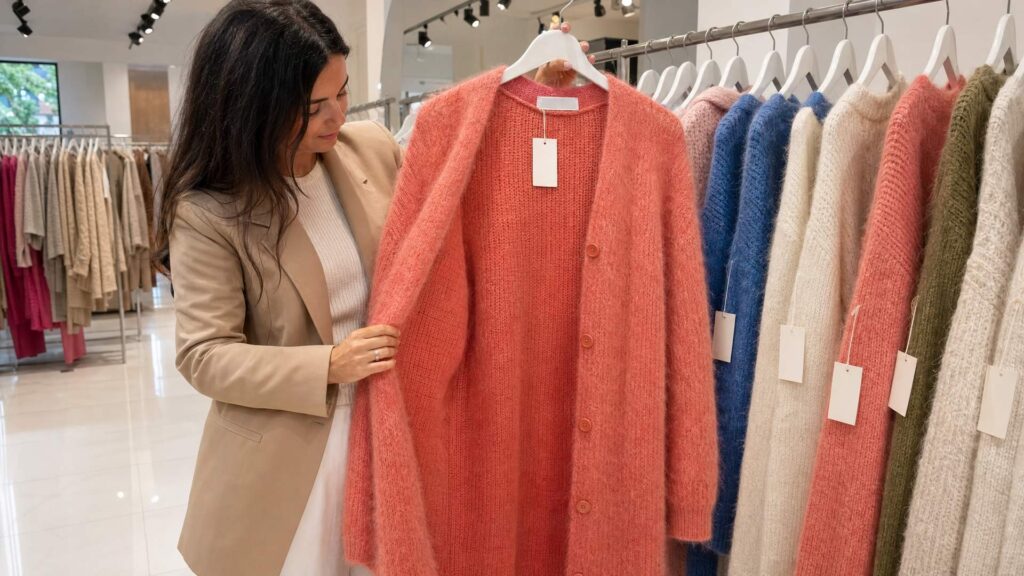
The pronto moda showrooms of Prato offer cardigans in a wide range of lengths and weights. Short cropped cardigans with pearl or contrast buttons sit at one end, often in soft brushed yarns and pastel colours, while long cardigans reaching the knee and coatigans with lapels, patch pockets and a heavier knit sit at the other. Between these two extremes there are relaxed hip-length shapes with dropped shoulders, which tend to be the safest choice for a first order, because they suit most body shapes and work over both trousers and dresses.
Coatigans deserve a separate decision. They are cut like a coat and knitted like a sweater, so they need a heavier gauge or a double layer to hold their shape. In the showroom it helps to ask the presenter to put one on and walk a few steps, because a coatigan that looks structured on the hanger may sag at the pockets or stretch at the shoulders once worn. A good coatigan keeps its line, and it is often the piece that customers buy instead of a second coat.
Buttons and trims are small details that change how a cardigan is perceived in the store. Pearl, horn effect or covered buttons can lift a simple knit, while plastic buttons that look too shiny tend to cheapen it, and the buyer can ask for a close look at them during the session. Pockets also matter more than they seem: patch pockets on a long cardigan are practical, but if the knit is light they can pull the front out of shape, so it is worth asking the presenter to put something in them and show how the panel hangs.
The yarn is where cardigans differ most, and the composition label tells the buyer what she is really looking at. In our sessions it is common to see labels such as a mix of mohair, acrylic, polyamide and wool in different proportions, each of which affects the feel and the behaviour of the garment. Mohair gives the halo and the lightness, wool brings warmth and recovery, while acrylic and polyamide add softness and strength at a more accessible level. Questions about whether these blends feel scratchy come up often, and our article on whether mohair is itchy explains how the share of mohair and its preparation change the feel against the skin.
Reading the label also helps with care instructions and with honest selling in the store. A cardigan with a high share of synthetic fibre can be very soft and very good value, but it should not be presented as a wool piece, and customers increasingly check composition before buying. Prato suppliers offer wool blends and cashmere blends rather than pure cashmere, so the buyer should look at the percentages on each label. Most of the goods in these showrooms are made in Italy, and when a supplier offers pieces made elsewhere this is always stated before purchase.
Cardigans are one of the categories where colour sells, and a rail of soft knits in powder pink, cobalt, coral, olive and cream is often more effective than a rail of neutral pieces alone. A practical approach is to buy a core of neutral long cardigans in cream, camel, grey and black, which sell steadily all season, and to add a smaller group of seasonal colours in shorter shapes, where customers are more willing to try something bright. The seasonal colours are also the ones that photograph best for the store’s social channels, and they often bring customers into the shop who then buy a neutral piece.
Depth should follow the role of each piece. Neutral long cardigans can be bought with more depth, three or four pieces per size, because they are restocked less often and sell to a wider audience. Bright cropped styles are better bought in small quantities and tested, since their success depends on the store’s clientele. Many cardigans in pronto moda are offered in one or two sizes, which keeps the order simple, but the buyer should still ask for the body length and sleeve length before confirming, particularly for long styles.
The pronto moda model suits cardigans particularly well because Prato produces knitwear continuously through autumn and winter. A buyer who sees a colour or a shape selling through in November can often find it again in the same showroom a few weeks later, or find a close alternative from another supplier working on the same seasonal codes. This makes it possible to start with a moderate order and build the rail during the season, instead of committing the whole knitwear budget in September.
Restocking does have its limits, and the most popular pieces can disappear from the showroom quickly. Keeping a short list of the suppliers and styles that sold best, and sharing it with the agent, makes the second and third orders much faster. Payment should follow the order as quickly as possible, since many suppliers in the district do not hold stock for long, and once the shipment is paid on a weekday morning the goods usually leave Italy within 24 hours.
Cardigans are a category where touching the yarn makes a real difference. Two cardigans with similar compositions can feel very different because of the gauge and the way the yarn has been brushed, and the difference is not always visible on a screen. Some buyers prefer to see these pieces in person at least once a season, to calibrate their eye and build a relationship with the suppliers whose knitwear suits their store. Even a single day spent touching yarns side by side tends to make later remote orders more accurate.
For those buyers, our in-person sourcing day in the Prato showrooms combines a planned route through selected suppliers with the time to handle the garments and compare weights directly on the rails. After that first visit, many buyers find it easy to continue with remote sessions for restocks, because they already know how the yarns feel and which suppliers to return to.
The information collected during this season is the best basis for the next one. A short record of the lengths that sold first and of the yarns that caused returns gives the buyer a clear brief for the following autumn. A store that knows its customers prefer hip-length mohair blends in soft colours, for example, can concentrate its first order on those and keep the experimental pieces for later in the season.
Stores that plan wholesale cardigans as a category running from October to March, instead of a single autumn purchase, usually find that it becomes one of the steadiest knit layers on the floor. In practice this means starting with a moderate order, going back to the same suppliers when a colour sells through, and describing each yarn honestly to customers, who then tend to come back for the same cardigan in another colour.
Italian fashion supply, curated and delivered to your inbox.
How can we assist?
See our services